

Every strategy and guide published by North Shore is backed by the board-certified expertise of our Co-Founders. With decades of combined experience in holistic admissions, Amy and Debbie ensure our guidance is objective, unbiased, and focused exclusively on your student's best fit.
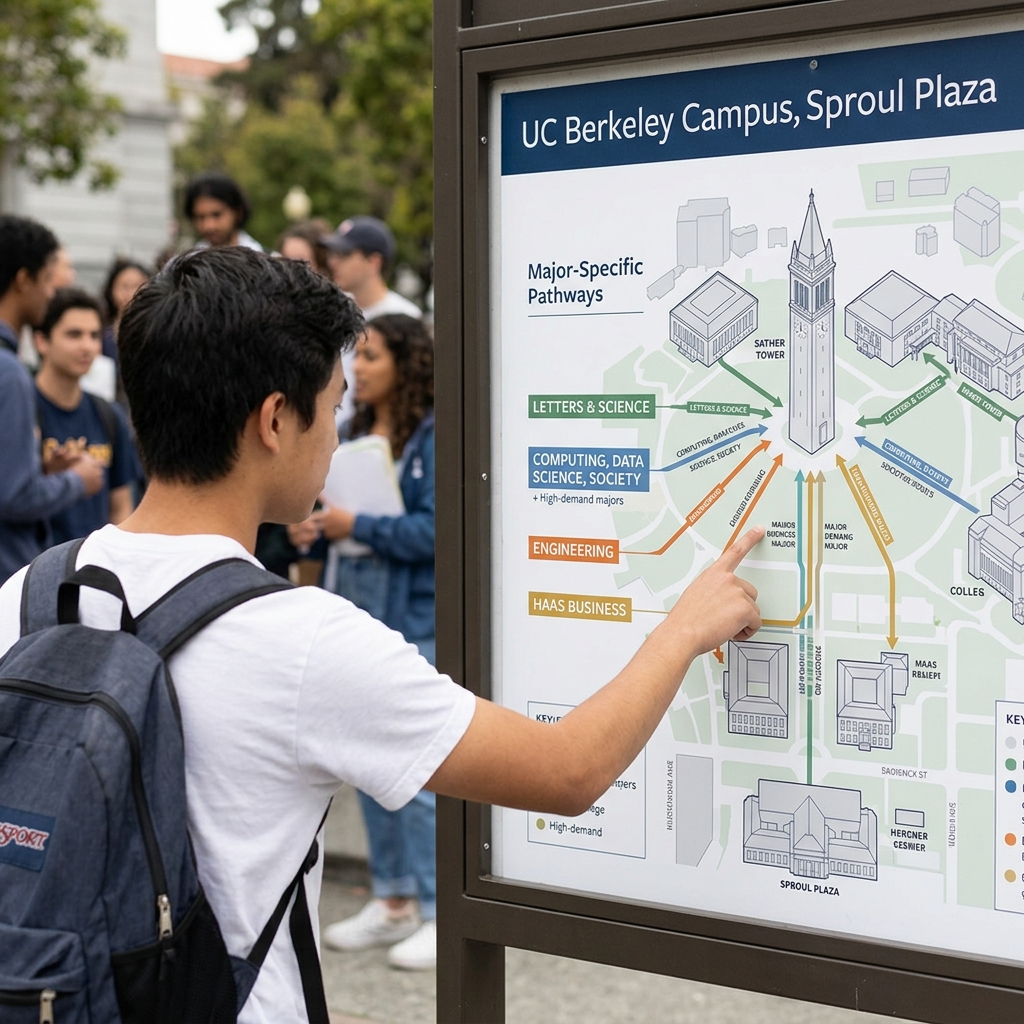
At UC Berkeley the primary major on the UC application can determine the admissions pathway. Berkeley's Application FAQs state that it guarantees review of the primary major only and will not review students for an alternate major. Several colleges then add their own rules: Letters and Science has five high-demand majors with a reserved-seat process; the College of Computing, Data Science, and Society admits directly to Computer Science, Data Science, or Statistics; Engineering applicants choose a named program or Engineering Undeclared; and Berkeley's three first-year business pathways carry three different consequences on denial. Berkeley is test-free, conducts no interviews, and has one filing period, October 1 through November 30, with no Early Action or Early Decision.
Most families approach Berkeley the way they approach a private university: get in first, sort out the major later. That model stopped describing Berkeley several cycles ago. The UC application asks for a college and a primary major, and at Berkeley that choice can route the file into a different program with different rules, and in the direct-admit colleges it decides what the student will be enrolled to study. Households argue about whether to list Computer Science or something safer, and most argue without knowing that Berkeley has published the answer, most recently in a February 2026 FAQ.
The answer sits in Berkeley's own pages: the Application FAQs, the L and S high-demand policy, the CDSS and Engineering admissions pages, and the three Haas program pages, each with a different rule for what happens on denial. This post reads all of them, then goes one layer further, to the question the documents do not settle and that we spend most of our Berkeley meetings on: what a student should list when the honest first choice is a restricted program and the file, as it stands in November, does not yet make that case.
The UC application lets a student select a primary major and an alternate major. Berkeley's Application FAQs, updated February 2026, say Berkeley "only guarantees the review of the primary major and will not review students for an alternate major," from any college, and recommend that a student with a strong interest in a specific major list it as the primary selection.
Two program rules operate separately from the alternate-major process, and Berkeley says so explicitly. A student not admitted to M.E.T. is considered for the corresponding Engineering major, with no guarantee of admission. A student not admitted to the Global Management Program is considered for the Letters and Science social sciences division; the Haas GMP page uses the word "may." Those are program-specific landings, not evidence that Berkeley reads alternates.
Our recommendation: choose the primary major as though the alternate does not exist, because for review purposes it does not. One operational detail that softens this: Berkeley's FAQ says a submitted major, college, or school can be changed by request through its Contact Us form, with a decision in five to seven days, and that no major changes are considered after January. A student who submits in November and reconsiders in December still has a window. After January, the primary major is final.
Sources: Berkeley Application FAQs (February 2026); ls.berkeley.edu high-demand page (list updated July 2, 2024); Haas high school students and GMP pages; met.berkeley.edu (September 2026); CDSS, Engineering, Chemistry, CED, and Rausser admissions pages, all accessed September 28, 2026.
Two things the table cannot show. First, Berkeley's fall 2026 decision guide says differences in program capacity affect admission outcomes, which is the school's own reason a campuswide admit rate is not any single applicant's number. Second, the internal-change rules after enrollment differ so much by college that "choose something easier and switch later" is not a strategy we would use without first reading the rules for the intended destination. The next four sections are those rules.
As of September 28, 2026, the L and S high-demand list is Art Practice, Operations Research and Management Science (Analytics), Political Economy, Public Health, and Social Welfare. The page carrying that list was last updated August 1, 2024, and L and S tells students to return to it for changes, so the student should recheck it the week the application is submitted.
A student who selects one of the five as the primary major and is admitted to L and S is guaranteed a spot in that major, subject to completing prerequisites, meeting academic standards, and declaring by the fifth semester. A student who enters L and S without selecting it can still pursue the major, but through one comprehensive review, with a non-high-demand backup required and no appeal if denied. Berkeley's admissions page calls the opportunities through that later route "extremely limited," and L and S says it cannot project how many students the review will admit because capacity is set at the time of review.
Older guides cause trouble here. Economics and Psychology came off the list in summer 2024, Global Studies and Media Studies in fall 2024, and Computer Science, Data Science, and Statistics moved to CDSS as of fall 2023. A guide that still calls Economics high-demand is a full policy generation behind, and the family reading it is optimizing against a rule that no longer exists.
The College of Computing, Data Science, and Society works differently from L and S. A first-year applicant chooses Computer Science, Data Science, or Statistics. CDSS does not admit first-years as undeclared, and an admitted student is enrolled in the selected major. For students admitted to Berkeley outside CDSS in fall 2024 or later, moving into one of those majors requires a comprehensive-review process, and CDSS's page notes that transfer rules are more restrictive still.
CDSS itself tells a student who is not sure what to study that they may prefer to apply to L and S as undecided. Our reading of that line: an undecided student has an undecided option elsewhere at Berkeley, and a student who lists CDSS is naming a specific academic path the rest of the application will be read against. Do not use CDSS as a speculative choice.
First-year applicants apply to a named Engineering program or to Engineering Undeclared. The route in from another Berkeley college is described by Berkeley Engineering's own change-of-college page as "very competitive and highly unlikely," the college does not accept change-of-college applications for EECS or the EECS joint majors at all, and a student admitted by change of college cannot later switch majors within Engineering. Engineering tells students who want the college to apply to it directly.
The preparation guidance is unusually concrete. Berkeley Engineering identifies sustained achievement in math and science, four years of mathematics, especially calculus, and at least three years of laboratory science, especially physics where available, as common ways applicants demonstrate preparation. Those are published signals, not universal requirements. Our advice: before finalizing an Engineering application, put the senior schedule next to that guidance. If calculus or physics is available at the school and missing from the schedule, the student should understand that Berkeley specifically names those subjects, and the academic record should still make sense for Engineering.
High school seniors have three direct-entry Haas pathways, and they do not share a fallback.
Spieker. A student applying to the four-year Spieker Undergraduate Business Program selects Business as the primary program; Haas says it will not review an application where a Haas program is the alternate. If the student is not admitted to Spieker, Haas states the student "will not be considered for admission to UC Berkeley." No Letters and Science landing. Spieker requires a Haas supplement with an essay question and a video interview upload, due in early January; Haas's page still carries a stale 2025 date, so the student should use the deadline in the MAP@Berkeley instructions that arrive after submission.
Global Management Program. GMP also requires a supplement with an essay and a mandatory video interview, due in early January 2027 per the current GMP page. A student not selected for GMP may still be considered for L and S; Berkeley's central FAQ describes that as consideration in the social sciences division. A documented path, not a guarantee.
M.E.T. The joint Engineering and Business program requires a 350-word essay and a video, due December 14, 2026 at 11:59 p.m. Pacific. A student not admitted to M.E.T. is considered for the corresponding Engineering major, and Berkeley's FAQ adds that admission to that major is not guaranteed.
For parents tracking this, the comparison that matters is not Haas versus the rest of Berkeley. It is Spieker versus the other two business doors, because Spieker is the only one where a denial ends the whole application.
For fall 2026, Berkeley received more than 133,000 first-year applications and admitted roughly 14,000, about 11 percent. Berkeley's August 2026 Student Profile reports 133,157 applications and 13,992 admits; UC's preliminary June data and Berkeley's July 29 announcement carry slightly different counts from earlier snapshots. The rate is campuswide, and Berkeley's fall 2026 decision guide says program capacity affects outcomes, so a Spieker applicant, a CDSS applicant, and an open L and S applicant are not competing in one lane. Do not substitute a third-party major-by-major admit estimate for Berkeley's current rules.
Berkeley's profile reports a middle 50 percent unweighted GPA of 3.90 to 4.00 and a Berkeley-reported weighted range of 4.36 to 4.72 for the fall 2026 admitted class. The UC GPA is its own formula: A-G coursework from the summer after ninth grade through the summer after eleventh, no pluses or minuses, honors weighting capped at eight semesters. For nonresidents, school-designated honors courses do not receive the extra UC honors point in the minimum-GPA calculation, although their rigor may still be considered in comprehensive review. A high school's own weighted GPA should not be compared directly with Berkeley's published ranges.
Berkeley is test-free, not test-optional. Its FAQ says SAT and ACT scores are not used "for any part of our process, including evaluation/holistic review, selection, or scholarship processes," and a submitted score changes nothing except placement or subject credit after admission. AP and IB results are different; the same FAQ says they are accepted as "value added" to demonstrate advanced proficiency. Berkeley's Application Tips page states that it does not conduct interviews and that the application is the only information it will have.
Berkeley's fall 2026 decision guide describes two independent assessments of every first-year application by trained readers, nearly 200 participating, with regular calibration meetings, and lists what readers considered: coursework and grades in context, grade patterns, senior-year rigor, advanced coursework available at the student's school, AP and IB Higher Level results, extracurricular accomplishment, leadership, employment, service, and personal qualities. What the public materials do not give families is a percentage formula. Anyone who tells you the PIQs are 25 percent is inventing a weighting Berkeley has not published.
The documents tell a student what happens after the decision. They do not tell a student what to list when the honest first choice is CDSS or Engineering and the transcript does not yet read like an applicant to it. That is where most Berkeley conversations in our office go, and what follows is our judgment, not Berkeley's policy.
One of our consultants previously read undergraduate applications for a UC campus. That experience informs the advice below, but Berkeley publishes no separate scoring formula by major, and we do not claim one exists. What we do see, consistently, is that a mismatch is easy to spot: the application names a highly specific academic path, and the coursework, activities, and PIQs show little sustained engagement with that field. That does not predict a denial. It does make the application less coherent, and coherence is what two readers working from the same file are looking for.
So the question is never which major is easier. Berkeley has said applying undeclared does not change admission chances. The question is whether the file, in November, supports the major the student wants. If it does, list it; the reserved seat in L and S is real, and CDSS and Engineering admit directly. If it does not, the choice families actually face is between listing the restricted program and accepting the higher bar, or listing an open L and S major and accepting that the later switch runs through a one-time review that Berkeley calls extremely limited. There is no guaranteed back-door strategy, and families who list Undeclared to be safe are usually choosing the second path without knowing it.
Spieker sharpens this to a point. Because Haas says a Spieker denial ends Berkeley consideration, listing Spieker is a decision to apply to Haas, not to Berkeley. A student whose file is strong for Berkeley but unproven for business should hear that before November 30, not in March.
First-year applicants answer four of eight Personal Insight Questions at 350 words each, and UC states that all eight receive equal consideration. Berkeley's PIQ guidance says the responses are read in the Admissions Office and in the Scholarship Office and are used to learn what is not evident elsewhere in the application; it tells applicants to explain not just what they did but the choices they made and what they gained. Then it publishes the reader's test: what do we know about this individual?
Our students usually arrive at the UC application after the Common App personal statement, and the instinct is to reproduce that structure four times: opening scene, arc, reflection, polished ending. Resist it. UC tells applicants to focus on content rather than writing style, and Berkeley says the PIQs are not evaluated on grammar or sentence structure. Treat them as information-rich short answers. Put the action early. Show decisions, responsibility, results, then reflection. Do not spend 90 words on atmosphere when 25 establish the situation.
Berkeley adds one instruction for applicants to professional colleges such as Engineering and Chemistry: it is important to discuss the intended field, interest in the specific major, and relevant school or work experience. That does not mean every PIQ is about engineering. It means an applicant to one of those colleges should not finish four responses without having made that interest understandable.
The four-answer test we use: beside each draft, complete "After reading this answer, Berkeley knows ______ about me." If two answers fill the blank the same way, one is wasting space. Then ask "What did I actually do here?" If the answer is hard to find, move the action earlier.
"Research intern." "Club president." "Founder." Labels tell a reader very little. For each important activity, the description should answer three questions: what did the student personally do, what responsibility or duration or scale makes that understandable, and what resulted. Not every activity needs a number; every important one needs more than a title. Berkeley's decision guide says readers weigh accomplishment in the context of the opportunities the student actually had, which cuts both ways: a branded summer program earns nothing by its name, and a job or a family responsibility can carry real weight when it is described.
The Additional Comments boxes, and the UC application has two, are for information that clarifies or completes the application: academic context, unusual circumstances, a nontraditional school environment, or relevant honors and activities that do not fit elsewhere. Berkeley's PIQ guidance permits all of that; UC says the box should not become another essay. And do not send unsolicited material. Berkeley's FAQ says portfolios, senior-year grades, and other supplemental materials will not be reviewed unless requested, and that it will ask when it wants more.
Berkeley says no. Its Application FAQs, updated February 2026, state that applying undeclared does not impact your chances of admission. That is a different question from whether program choice affects the pathway. Berkeley's decision guide says program capacity affects outcomes, and several colleges admit directly into majors or programs, so the major a student lists can change which process reads the file and what happens after admission, even though undeclared itself is not an advantage.
Do not count on it. Berkeley's Application FAQs state that it only guarantees review of the primary major and will not review students for an alternate major, from any college. Haas will not review an application where a Haas program is the alternate. Two programs have their own documented landings, separate from alternate-major review: M.E.T. applicants not admitted are considered for the corresponding Engineering major without a guarantee, and Global Management applicants not selected may be considered for the Letters and Science social sciences division.
As of September 28, 2026, Berkeley's Letters and Science high-demand list is Art Practice, Operations Research and Management Science (Analytics), Political Economy, Public Health, and Social Welfare. Economics and Psychology were removed in summer 2024, Global Studies and Media Studies in fall 2024, and Computer Science, Data Science, and Statistics moved into the College of Computing, Data Science, and Society. The L and S page was last updated in 2024, so the student should recheck it immediately before submitting.
Haas states that a high school applicant not selected for the four-year Spieker Undergraduate Business Program will not be considered for admission to UC Berkeley. There is no fallback to Letters and Science. Spieker requires a supplemental application with an essay question and a video interview upload, due in early January. Berkeley's other two direct-entry business pathways work differently: a Global Management denial may be considered for the L and S social sciences division, and an M.E.T. denial is considered for the paired Engineering major without a guarantee.
November 30, 2026. The UC application opened August 1, the filing period runs October 1 through November 30, and Berkeley offers no Early Action or Early Decision. Program supplements follow: M.E.T. is due December 14, 2026 at 11:59 p.m. Pacific, Global Management in early January 2027, and Spieker in early January with the exact date in the applicant's MAP@Berkeley instructions. Berkeley's FAQ says a submitted major can be changed by request until January. Decisions post at the end of March, and the deadline to accept an offer is May 1, 2027.
No to both. Berkeley calls itself test-free and says SAT and ACT scores are not used for any part of its process, including holistic review, selection, or scholarships; submitted scores are used only for placement or subject credit after admission. AP and IB examination scores are accepted as value added to show advanced proficiency. Berkeley's Application Tips page says it does not conduct interviews and that the application is the only information it will have, which makes the PIQs the student's one chance to add what grades and course titles cannot.
What Your Student Should Do
Three moves, in order.
Lock the primary Berkeley pathway before polishing a single PIQ. Put the student's intended major in one row of the table above: open L and S, an L and S high-demand major, CDSS, a named Engineering program or Engineering Undeclared, Spieker, GMP, M.E.T., Chemistry, CED, or Rausser. Read the current rules for that row on Berkeley's own page, recheck the L and S high-demand list the week of submission, and if Haas is in play, decide which of the three business doors the student actually means, because Haas says they do not share a fallback.
Audit the senior schedule against the intended college before November 30. Berkeley's decision guide says senior-year rigor is considered, and senior grades are not accepted as an update, so the schedule is the evidence. Engineering applicants should compare the schedule with Engineering's published math and science guidance and, if calculus or physics is available but absent, decide whether the record still reads as an Engineering file or whether the academic Additional Comments box needs to explain the choice.
Draft all four PIQs as a set by October 20 and run the four-answer test. Write "Berkeley now knows ______ about me" beside each draft and fix duplication. Move the action earlier wherever it is hard to find. For Engineering and Chemistry applicants, confirm the set addresses the field, the specific major, and relevant experience, because Berkeley explicitly tells those applicants to do so.
One calendar wrinkle: the supplements arrive after the UC deadline on three different dates, December 14 for M.E.T. and early January for GMP and Spieker, and a Berkeley letter invitation, if it comes, goes to a small percentage of applicants between October and early December with a January 10 due date, at least one letter from a teacher or instructor. The student should watch email and MAP@Berkeley from the day after submission, and should name one academic recommender before winter break rather than starting from zero if the request lands over Thanksgiving.
Want the rules in two pages? Download the Berkeley College and Major Map: every pathway, its fallback rule, and its supplement date, current as of this post's Updated date.
You don't have to navigate the complexities of college admissions alone. Whether you are aiming for the Ivy League, a top-tier public university, or a highly selective major, our expert counselors are here to help you craft a personal brand that stands out.