


Every strategy and guide published by North Shore is backed by the board-certified expertise of our Co-Founders. With decades of combined experience in holistic admissions, Amy and Debbie ensure our guidance is objective, unbiased, and focused exclusively on your student's best fit.
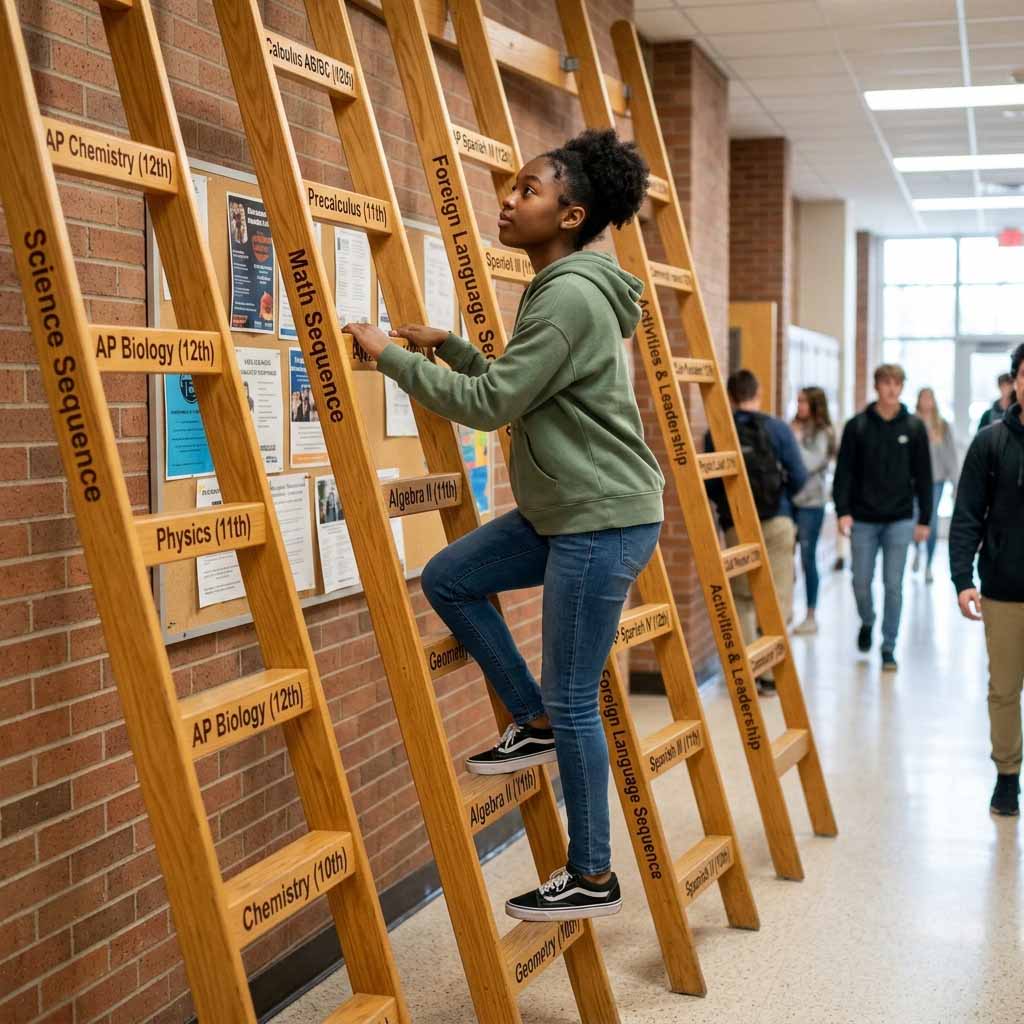
Sophomore year has a reputation as the year nothing counts. No applications, no deadlines with a college's name on them. But sophomore year college planning is real, and it is narrow: it comes down to ladders that only climb in one direction. Courses run in sequences where this year's rung decides which rungs exist senior year. Activities run the same way, because depth and leadership are built on time served, and time cannot be added later. The parts of the application a reader weighs most, the ascending senior schedule and the activity list with real consequence behind it, are largely constructed in tenth grade, before anyone is thinking about readers.
The direct answer for what a sophomore should actually do: keep all five core subjects climbing, stay on the math and language ladders past the point of comfort, and commit real time to the one or two activities worth deepening, because both the transcript and the Common App activity list will later show exactly when the climbing stopped.
Three ladders carry nearly all of the curricular weight.
Math is the strictest. Every math course requires the one before it, so the sophomore course sets the senior endpoint. A sophomore in geometry typically lands in precalculus as a senior. Reaching calculus by senior year requires being one course further along now, in Algebra 2 as a sophomore. For a student aiming at engineering, business, or any quantitative program, that difference in the transcript's final line matters, and it cannot be created junior year. Summer bridges and doubled-up years exist at some schools, but they are exceptions a student has to engineer, not defaults. When a family asks in eleventh grade how to get to calculus, the honest answer is often that the question was decided in ninth or tenth.
Language is the most commonly abandoned. The graduation requirement at most high schools is two years. What selective colleges want to see is usually depth through level four, and the gap between those numbers is where sophomore-year damage happens. Dropping language after sophomore year feels costless because it satisfies the school's requirement. The price appears two years later, when the transcript ends at level two in a pool of transcripts ending at level four, and there is no senior-year fix. The ladder was exited; the ladder is gone.
Science sequencing sets up the APs. At most schools the advanced sciences sit behind the core sequence, and which advanced courses are reachable senior year depends on the order and level a sophomore is climbing now. A student aiming at engineering or pre-med reads differently ending on advanced physics or chemistry than ending where the sequence ran out.
The tool for all three is the document pairing from our transcript post: the program of studies, which shows every ladder and its prerequisites, and the school profile, which shows what the most demanding path looks like to the reader. Your student maps backward from the senior line they want the transcript to end on.
Here is the detail most families learn too late. The Common App activity list does not just ask what a student did. For every activity, it asks which grade levels they participated. A reader sees 9, 10, 11, 12 next to one activity and 11, 12 next to another, and the difference is information. The club presidency that begins junior year on top of two years of visible membership reads as an earned outcome. The same title attached to an activity that first appears junior year reads as list-building, and readers have seen thousands of both.
That is why sophomore year is the depth year, and depth follows the same one-directional logic as calculus. The framework we use for activity strategy, the ISC Framework, evaluates what an activity shows through Impact, Scale, and Consequence: what changed because the student was there, how far it reached, what would have been lost without them. None of those accrue in a semester. Impact takes time to produce; consequence takes time to become visible; and the leadership roles that get awarded in eleventh grade go, almost mechanically, to the students who put in the tenth-grade hours while nobody was watching.
The sophomore move is narrowing, and it belongs to the student. Freshman year is for sampling. Sophomore year is when the student picks the one or two commitments worth going deep on and starts doing the unglamorous work inside them: taking on the project nobody wants, learning the thing the club actually needs, becoming the person the group depends on before any title says so. What sophomore year is not for is accumulating entries. Ten activities with 10, 11, 12 checked and nothing underneath them is a pattern readers recognize instantly, and the ISC questions come back empty on every one.
The other sophomore-year fact runs in the opposite emotional direction, because it is good news. Families treat a rough sophomore semester as permanent, and that is not how the file reads. Two mechanics from the reading side, both covered in our transcript post: many colleges rebuild GPA from core academic courses under their own formula, and readers evaluate trajectory, not a frozen average. A sophomore dip followed by a stronger junior year inside rising rigor reads as a student who found their footing, and from what admissions officers we know describe, an ascending line out of a weak start is one of the more sympathetic shapes a transcript can take.
Put the mechanics together and sophomore year's real logic appears. Grades are recoverable. Sequences, in courses and in activities alike, are not. A family reacting to a hard semester by pulling the student down a math level, out of a language, or off their deepest commitment has traded the recoverable thing for the unrecoverable one, usually to protect a GPA the colleges will recalculate anyway.
Four moves, in order.
Map the ladders backward. Your student pulls the program of studies and school profile from the high school's website and writes down, for math, language, and science, the senior-year course each sequence should end on, then checks whether this year's schedule keeps that rung reachable. Twenty minutes, three subjects, one page.
Audit this year's schedule while it can still move. August and early September are the last window to correct the current year: all five core subjects present, level held or climbing in each. A missing language or a coasted math level is fixable this month and expensive later.
Pick the depth commitment. The student chooses the one or two activities that will carry their 9-through-12 arc and names, in a sentence, what they want to be responsible for in each by the end of this year. Responsibility, not title. Titles follow the students who did this.
Treat the winter course-selection form as the real deadline. Junior-year courses get chosen mid-sophomore year on a form that arrives with no ceremony and gets signed in a week. It is the highest-leverage college-planning document of the year. The student who mapped the ladders fills it out in five minutes on purpose. Everyone else fills it out in five minutes by default.
Q: Do colleges look at sophomore year grades?
A: Yes. Sophomore grades are on the transcript and inside any recalculated GPA. But they are read as part of a trajectory, and a stronger junior year inside rising rigor substantially outweighs a rough sophomore patch. Grades are recoverable in a way that abandoned course sequences are not.
Q: What classes should a sophomore take for college?
A: The ones that keep the sequences climbing: all five core subjects, language continued past the graduation requirement, math and science at the highest level the student can genuinely handle. The specific answer lives in the school's own program of studies, mapped backward from the strongest available senior year.
Q: What activities should a sophomore do for college?
A: Fewer, deeper. Sophomore year is when the student narrows from sampling to one or two real commitments and starts building responsibility inside them. The Common App activity list will later show which grades each activity spans, and depth that starts in tenth grade is visible in a way junior-year additions never are.
Q: Is sophomore year too early to start college planning?
A: For application activities like essays and lists, yes. For sequencing, it is nearly the last call. This winter's course-selection form determines junior rigor, and the commitments deepened this year become the activity list's strongest entries. Planning now is not pressure; it is keeping options open cheaply.
Q: Should a sophomore drop an honors or accelerated course after a bad semester?
A: Sometimes, but knowingly. Stepping down trades an unrecoverable rung for grade relief colleges may recalculate away. Before the change, the student should be able to say what the senior-year endpoint of each option looks like, because that endpoint is what the reader will see.
You don't have to navigate the complexities of college admissions alone. Whether you are aiming for the Ivy League, a top-tier public university, or a highly selective major, our expert counselors are here to help you craft a personal brand that stands out.